Civil & Commercial UAS

A structured overview of small unmanned aircraft systems (sUAS) in the civil and commercial sector.
1. Scope
This page provides a neutral reference on:
What qualifies as a small UAS
Aircraft categories and core system components
Major commercial manufacturers
Common industry applications
FAA Part 107 certification (U.S.)
Regulatory fundamentals
Education and entry pathways
It is informational. It does not provide tactical instruction, regulatory workarounds, or operational shortcuts.
2. What Is a Small UAS?
In the United States, a small unmanned aircraft system (sUAS) generally refers to:
An unmanned aircraft weighing under 55 lbs
Operated for commercial, industrial, public safety, or research purposes
Governed primarily by FAA Part 107 (for commercial use)
Core System Components

A typical sUAS includes:
Airframe (multirotor, fixed-wing, or hybrid)
Flight controller
Command & control link
Positioning system (GNSS)
Payload (camera, LiDAR, thermal, multispectral, etc.)
Ground control interface
Understanding the system architecture matters more than memorizing individual models.
3. Aircraft Categories
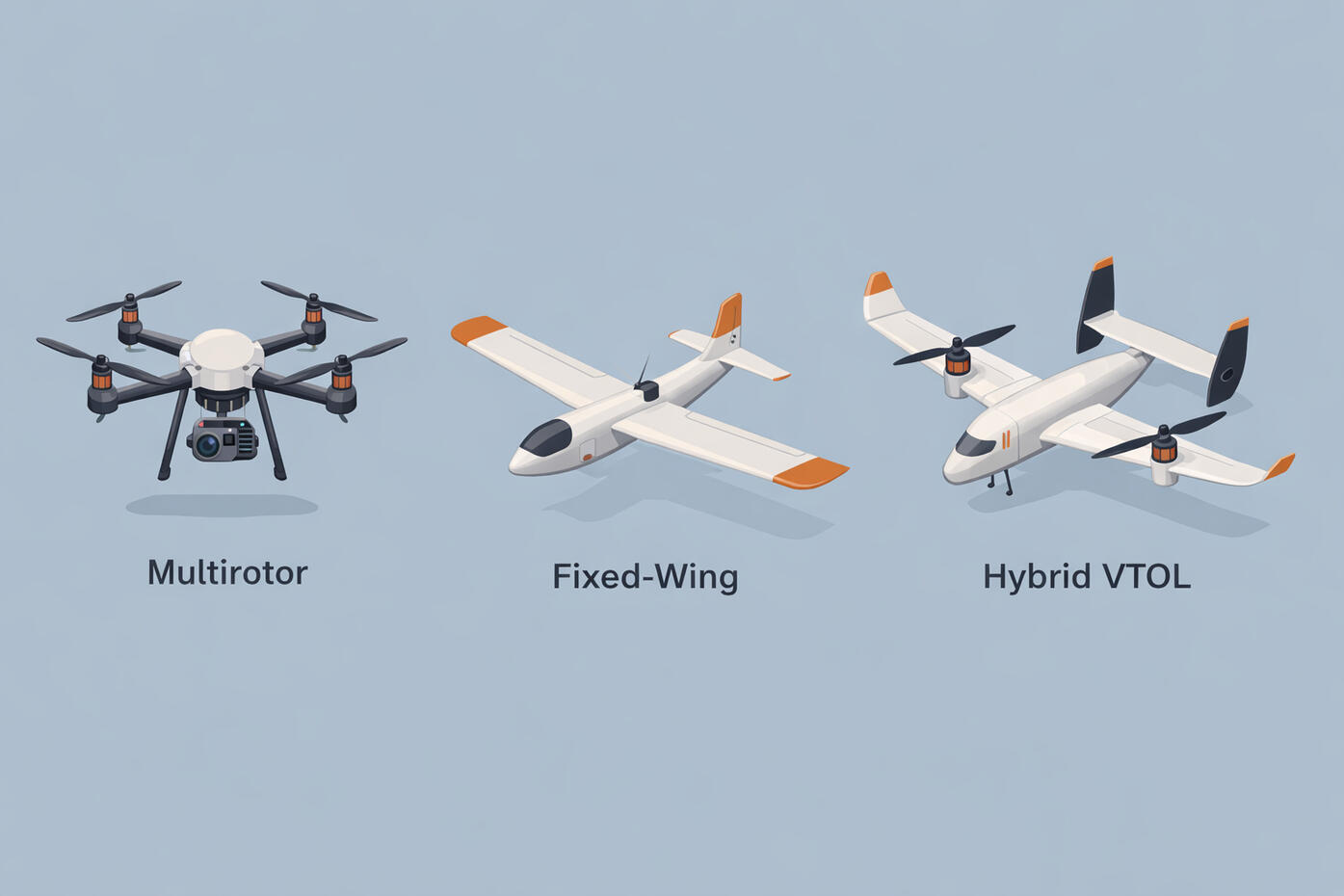
Multirotor
Vertical takeoff and landing
Hover capability
Precise positioning
Shorter endurance
Common uses: inspection, construction monitoring, public safety documentation.
Fixed-Wing
Longer endurance
Efficient over large areas
No hover capability
Common uses: agriculture, surveying, environmental mapping.
Hybrid VTOL
Vertical takeoff with fixed-wing forward flight
Increasing adoption in commercial mapping
Combines endurance and deployment flexibility
4. Major Commercial Manufacturers
Enterprise / Commercial Platforms
DJI
Autel Robotics
Skydio
Parrot
Industrial & Mapping-Focused
Wingtra
Quantum Systems
AgEagle (senseFly lineage)
U.S.-Based Security-Oriented Platforms
Skydio
Teal (Red Cat Holdings)
Selection depends on mission type, regulatory constraints, and data requirements—not brand preference alone.
5. Common Commercial Applications
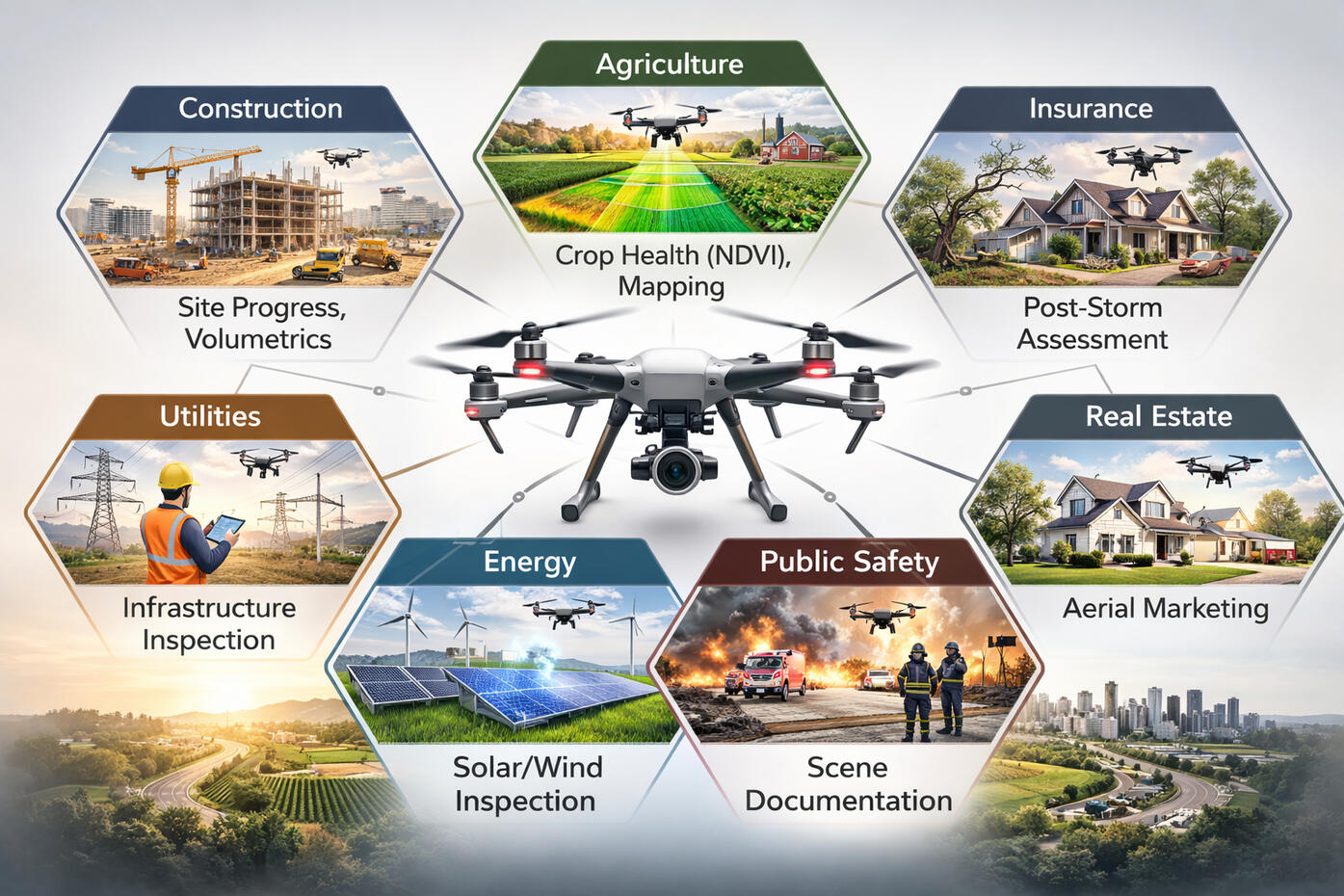
| Industry | Typical Use |
|---|---|
| Construction | Site progress, volumetrics |
| Agriculture | Crop health (NDVI), mapping |
| Utilities | Infrastructure inspection |
| Insurance | Post-storm assessment |
| Energy | Solar/wind inspection |
| Public Safety | Scene documentation |
| Real Estate | Aerial marketing |
In most sectors, drones reduce risk exposure, improve data frequency, or increase survey efficiency.
6. FAA Part 107 Overview (United States)
What it is
Part 107 is the federal certification required to operate a drone commercially in the U.S.
Basic Requirements
Minimum age: 16
Able to read, write, speak, and understand English
Be in a physical and mental condition to safely fly a UAS
Pass FAA knowledge test
Apply via FAA IACRA system
Knowledge Areas Tested
Airspace classification
Weather fundamentals
Aircraft loading & performance
Emergency procedures
FAA regulations
Crew resource management
General Process
1. Study FAA knowledge domains
2. Schedule exam via PSI testing center
3. Pass exam
4. Apply through IACRA
5. Receive temporary certificate
Recurrency training is required to maintain currency.
7. Regulatory Fundamentals
Airspace
Classes A–G
Controlled vs uncontrolled airspace
Authorization required in certain airspace
LAANC
Low Altitude Authorization and Notification Capability (LAANC) allows near real-time authorization in controlled airspace.
Remote ID
Most drones operating in U.S. airspace must comply with FAA Remote ID requirements.
Waivers
Certain operations (e.g., night flight, BVLOS) may require waivers or additional compliance measures.
Regulations evolve. Operators are responsible for verifying current rules.
8. Education & Entry Pathways
Formal Education
College UAS programs
Aviation technology degrees
Engineering tracks with UAS integration
Self-Directed Learning
FAA publications
Manufacturer training materials
Industry webinars and white papers
Certification Options
FAA Part 107
Manufacturer training certifications
Safety and risk management programs
Some online platforms like Vets to Drones offer reduced-cost or sponsored certification tracks through institutional programs.
9. Risk & Responsibility
Professional operation includes:
Privacy awareness
Data security
Insurance coverage
Equipment maintenance
Airspace compliance
Ethical flight conduct
Commercial drone operation is regulated aviation activity, not hobby experimentation.
10. References (Authoritative Sources)
This page is a structural overview of the civil UAS ecosystem.
It does not:
Provide tactical guidance
Offer evasion techniques
Critique specific systems
Rank manufacturers
Provide business consulting
Contact:
[email protected]
All content and resources provided by Remote Warrior LLC are for informational and educational purposes only. Nothing on this site should be interpreted as legal, medical, or clinical advice, nor does it represent the official policy or position of the United States Department of Defense or U.S. Air Force. Use of any material is at your discretion and does not create a professional or therapeutic relationship. For questions related to health, safety, or legal matters, consult a qualified professional.
© Remote Warrior